Sunday, February 22, 2015

The Power of Poetry Panel Discussion Questions

The best story I can think of that illustrates the power of poetry is Nelson Mandela, who died on December 5, 2013.  Mandela spent 27 years between 1962 and 1980 in prison.  The anti-apartheid peaceful revolutionary was not defeated by his imprisonment instead during his confinement at the Robben Island prison, Mandela studied law by correspondence at the University of London, learned Afrikaans to foster a rapport with jailhouse wardens, and was instrumental in launching the “University of Robben Island”, where prisoners possessing expertise in particular fields presented lectures to their fellow inmates.  However he was cruely treated.  Like Gandi and MLK, he patiently persevered. In an interview with Charlie Rose, above, Morgan Freeman discusses Mandela’s reliance on William Ernest Henley’s 1875 poem, “Invictus,” to keep his hope alive: “That poem was his favorite… When he lost courage, when he felt like just giving up — just lie down and not get up again — he would recite it. And it would give him what he needed to keep going.”
Freeman, who played Mandela in the 2009 film Invictus, also provides a solemn and dignified recitation of the poem. Although this poem is strongly connected to Mandela in his times of despair, its words of courage have served as inspiration to countless others. Famous figures who have drawn hope from “Invictus” include the father of Burmese opposition leader Aung San Suu Kyi during his struggle for Burmese independence and tennis champion Andre Agassi. Rumor has it that U.S. President Franklin D. Roosevelt was also quite fond of it.

“Invictus” 
Out of the night that covers me,
Black as the Pit from pole to pole,
I thank whatever gods may be
For my unconquerable soul.
In the fell clutch of circumstance
I have not winced nor cried aloud.
Under the bludgeonings of chance
My head is bloody, but unbowed.
Beyond this place of wrath and tears
Looms but the Horror of the shade,
And yet the menace of the years
Finds, and shall find, me unafraid.
It matters not how strait the gate,
How charged with punishments the scroll.
I am the master of my fate:
I am the captain of my soul.

.
Ilia Blinderman is a Montreal-based culture and science writer. Follow him at @iliablinderman.
Related Content:
Nelson Mandela Archive Goes Online “Invictus” Free Audio Books and Free eBooks collections.

Questions for the panel discussion:


In your opinion, what makes a poem a poem? What does it take for  a poem to be good for you?

In what ways do you think poetry is powerful?

Do you have a favorite poem that defines who you are and / or grounds you?  What is the history of that poem in your life?

Where are the various places we find poetry?  Are the lyrics of songs considered poetry? 

Can anyone write poetry? Why would you write poetry? Do you need to study this form of literature to write poetry?

Is poetry relevant?  Does it matter?  Is it part of our culture?

Who would you say is the greatest American poet?  What do you think is the greatest American poem?


Where is Your New Vision?

By Daniel Nie

(Daniel will be speaking at the CHS Read across America event on Wednesday, Feb. 25th from 9:10-9:45.  He will also be selling and signing his books and creating Coolligraphy for those interested.)

Where is Your New Vision?

By Daniel Nie

I am an artist. I sell my artwork for living. I need middle class people to buy my art.  Then, if thousands of the middle class make a good income, they may have money left over, after paying for living expenses, to buy my art.

When the middle class have money, an artist can make a good living if he is willing to work hard, because the number ratio of artists vs. the general population is good. That means, even if the artist can paint only fishes,  even if there is only a small percentage in the population in the U.S. who would purchase his fish paintings, he would have enough business. He could make $1000 if he sells 20 pieces at $50 each. He would be able to make $100K, if he produces and sells 2000 pieces (It is possible for an artist to produce that many, or even more pieces of quality paintings per year; I have!)

When the middle class has money, the artist can be confident that he can make more money if he works harder. Many common artists (average artists, not necessary famous ones) have done that in the 80's or earlier. I was one of them!

Now it is a different situation. The middle class no longer has much disposable income. To buy original paintings is now a luxury for the middle class and consequentially this has changed our culture. Many people do not care about the difference between a print mass produced in China and hand painted artwork by a local artist.

What should I do to make a good living as an artist who may not have any other skills or talents? Find a real job? The real jobs I could find may not pay much at all. So, even if I work 2 minimum wage jobs, I still cannot make enough to be considered middle class.  If I sell my art only to the rich people, although I may sell at $5000 per piece (sounds pretty good, doesn’t it?), there is not enough rich people out there who just happen to love my fish paintings. It would be considered very lucky for me to sell 4 pieces per year at $5000 each, but I would still be considered low income, making only $20K per year. With this low income, I will never be able to afford to live in an upper middle class neighborhood. Am I right? So how can I be a member of the upper middle class if I am willing to work my fingers off as a common artist?

Fortunately, I am not that poor artist, described above, whom I pretended to be. My point here is that the New America is not the same one I found in 1981. I do not know if I could make it if the economy and culture, at the time I started my art career, were what it is today.

In the past, as long as I was willing to paint, and willing to work 20 hours a day to produce as many paintings as I could, I did not need to worry that my paintings wouldn't sell. The buying population and the culture were there. Unfortunately, that is not true anymore.

Before, anyone, as long as he was willing to work 2 shifts, could work in the factory ----his time was money. But not anymore, it is no longer easy to find a place to work overtime even if you do not mind to sweat.

In generations past, one did not have to graduate from college or even from high school; he could get a good job on an assembly line that paid well. Now, you have to be outstanding, gifted, or someone who has connections and resources in order to get ahead.

In this new globalized world where jobs are off shoring and men are being replaced by robots, how can we recreate a middle class with a lot of disposable money? Is it possible? My answer is Yes! It is absolutely possible. We can make the changes necessary for the middle class to have disposable income once again.  Here is my vision and plan:


People no longer look for conventional employment.  They create work that is in demand by customers who prefer human-to-human services. However, this culture of human services has to be to be developed first. That means we need to establish some qualified people to promote such a culture.

80% of the population need to have money, enough money, that will make a life style change. Once they make a high income; they do not need much savings; they love to spend; they desire a better life style than the one they are accustomed. In order to reach this as a cultural reality, we first need to ask a key question: How can we make it possible for people to be able to make more money when they work harder even though this world has fewer and fewer conventional job openings? We need to research and find the kind of new political and economic system that can make this vision a reality. Who will be the legal entity or architect to carry this out?

The government will not do this job for people. The rich and powerful will not initiate this goal for the people. The people themselves have to wake up. They should not be distracted by the Left or the Right but focus on the real issues with a scientific approach to the social and economic problems that linger with them since off shoring and robots. People need an awareness to focus on the real issues!  Do our leaders have the will to call on researchers that could bring about real change that would update our American culture and society in a fundamental way? Are we confident enough to commit ourselves to renew our minds and spirits, so our ideology can be compatible to this globalized world?

How can our social and political system catch up with the leaping forward technology? If we do not ask these questions, we are kicking the can down the road; we are insane, as Albert Einstein said, doing the same thing over and over again and expecting a different result.

2015


Friday, February 20, 2015

Ming visited CHS through a Hangouts session yesterday.  Here are some of the points he made about Soft Skills like communication.

Think about the impression you are making from the perspective of the other person.  Think about What Is In It For Me from their view point.  This is called WIIFM.  There are three major parts:

1. Visual - the way you look, from the moment you slip in front of the audience, 55% of the message
2.Vocal - the way you speak, 38% of the message
3. Verbal - your words, 7% of the message

All else is small potatoes!

Think about this:  93% of the message you want to get across depends on the way you look and your tone of voice!

Your tone says to the listener :  you are worth my effort and my message is worth it.  The first impression comes from the the way you look and your tone of voice.  Remember the old cliche' It doesn't matter what you say, but how you say it. 

In this series of blogs, I will draw from the knowledge, skills and wisdom of Ming Diaz.  What we will focus on is Dress, Tone and acceptable manners

The Visual Drives the Message!  

1.  Collared shirt (blue to white) buttoned down (lowest level is no collar) you must have a collar! This brings attention to the face.  Hint: it is valuable to have at least 3 shirts with cuffs.  

2.  Grease collects on the brow and upper side of face.  Take away this distraction by using a neutral set powder.  

3.  Always a belt!  Dress the part and get the recognition.

4. Only one item of jewelry and a gold watch for men.  Women ear rings and a matching penant.

5.  Good posture is a Fierce Enhancement as the message giver!  This will make a ferocious difference!  There are two inches between cowering and towering.

The Responsibility of an Envoy

1.  React on the behalf of others.  If you take away their fear, you are taking care of your customer.  Let them know there are no worries.  You will protect them.

2. Take care of their needs: for example:  bring them water and take them to lunch.

3.  Assure them they will not lack for anything.  This moment this place you say, let me make you important and comfortable.  (anthropology - like the monkey grooms - hygiene is what is necessary.

4.  You are in your domain, you are the guests best friend.  You remove their stress, treats and fear.  You are a visual anchor and they feel say knowing you are there.

Confidence 

1.  Basic rule as your confidence grows your rate of speaking slows.  Slow down at the end of what you want to say.  

2.  Enunciation makes up for quality.  

3.  Your dress is important.  

4.  Give good eye contact.

5.  Use a stance of inclusion.  You body language will include if you use open hands as long as it is no higher than your collar bone.  Stay in the area below the collar bone.  Any higher is the gorilla stance and is perceived as threatening and a sign of insecurity .

6.  Do not touch your face: a sign of subservient.

7. Make it until you fake it.  Do the things you know.  Good posture.  An obvious sign of stress and being unsure of self is touching the face.  These nuances are a way to deliberately  teach yourself automatic habits of not making the other person uncomfortable.    Work towards unconscious confidence.  

8.  Attention away from sex.  Draw attention to your face.  Hair away from face.  Women choker and matching earrings.  Solid colors best, then patterns, no logos.  

9.  Visual competence is 3 x as hard for a woman than for a man.  Impression of Competence depends on the quality of your dress and the style enhances the message. Single color dress draws attention to the face.  Non-glare make-up.  Hair away from face.  Think about how you present yourself especially if you are a female.  For females you must present your professional side more than your female side to break the glass ceiling.  

10.  Dress for success, dress professionally, dress conservatively which defines trust.

https://www.dressforsuccess.org

http://www.mindtools.com/selfconf.html

Thursday, February 19, 2015

Annie Levesque, Motivational Artist

Several years ago I made a pilgrimage to Sainte-Anne-de-Beaupré a small town in La Côte-de-Beaupré Regional County Municipality, Quebec, Canada, along the Saint Lawrence River, 35 kilometers (22 mi) north-east of the Quebec City. In this small town there is a huge, beautiful basicilica.  While walking around this quaint town that appears to be set back in the 50s, we couldn’t help but notice a colorful building decorated with creative art and bright colors. Walking in we were greeted by Annie, an enthusiastic and adorable young lady, who we discovered to be the owner and the artist of many of the beautiful pieces of art on display.  Annie pointed out many of the unusual pieces and how through them we are forced to think outside the box.  She stated, we are often too busy to take the time to be playful.  When we stress, we get stuck in the way we see things, kill our creativity and are less productive. She continued,  art may help us to relax, be playful and to take on a different perspective.  Her carnival mirrors distorted our image which made us laugh and we played an unusual hopscotch game that instructed us to do silly things when landing in each box.  I was totally engaged. The bottom line:  it is important to relax and be playful.  

When she saw how much we were enjoying ourselves, she opened up.  We asked her many questions, and she answered our questions candidly.  Then she told us her story.  Her parents sent her to the university to study science, but instead she majored in art.  When she came home they were disappointed, but finally consented to her staying in the art program.  The art studio she was managing was actually a part of her class project.  Here she supported artists who she believed in.  Both of her parents were both working for her.  What a twist of events!  Annie is an inspiration to me because of her passion, initiative and ability to follow her dream no matter what.  I admire Annie for her belief in and support of herself.  Moreover, I am impressed with the way she reaches to support others.  Annie is truly a motivational artist!    


Wednesday, February 18, 2015


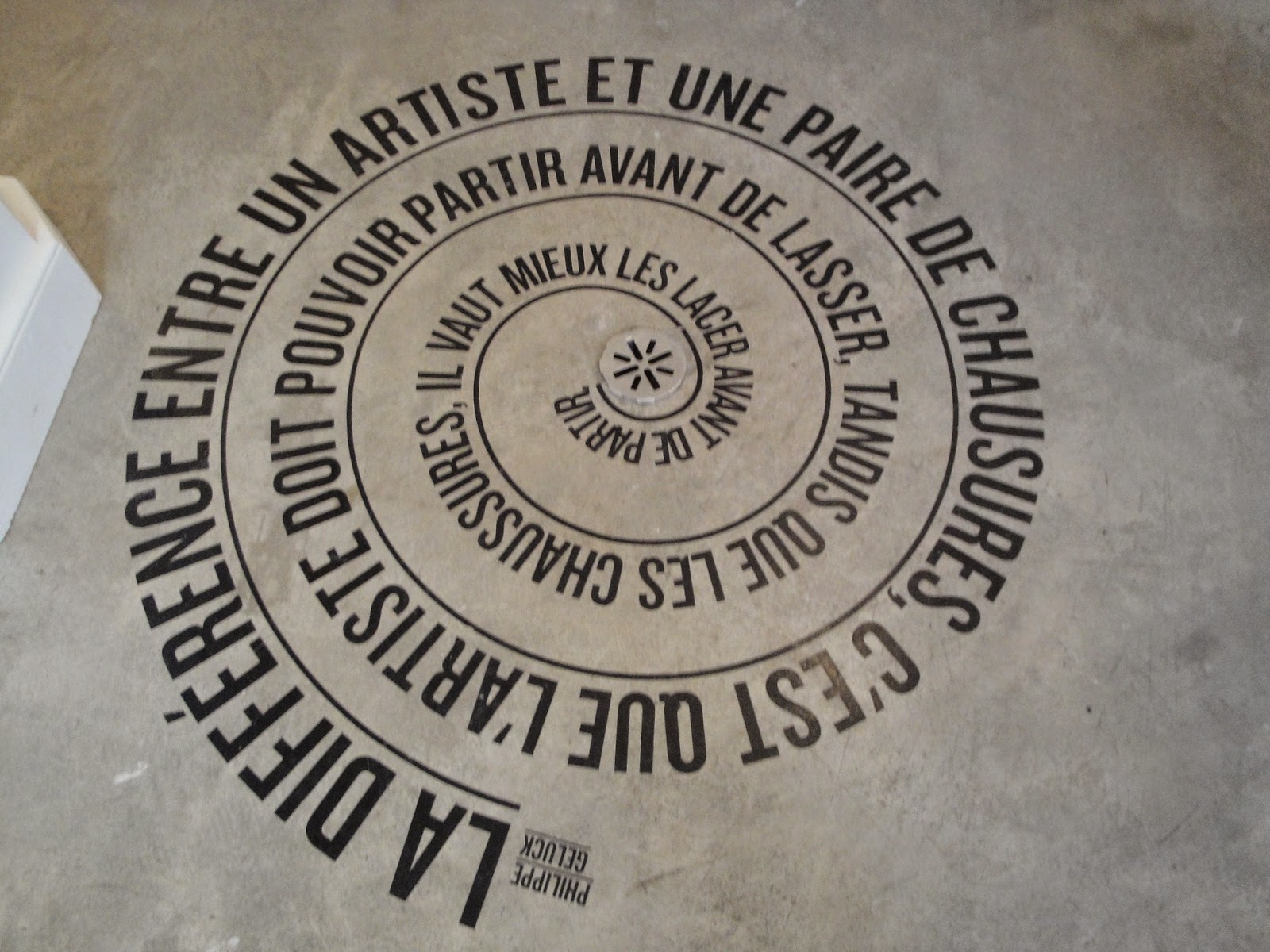
The banner on my Twitter page is a play on words by humorist, comedian and cartoonist Philippe Geluck.

The difference between an artist and a pair of shoes.  The artist must stop before he laces up and the shoes are not finished until being laced up.  In French, laced up is an expression for go crazy.
 
In French it states:
La differnece entre un artiste et une paire de chausures, c'est que l'artiste doit pouvoir partir avant de lasser, tandis que les chaussures, il vaut mieux les lacer avant de partir.

In English it means:
The difference between an artist and a pair of shoes is that the artist must leave before tiring, while the shoes, it is better to lace up before leaving.  I believe the phrase lace up means tire or go crazy.

More on why I choose it later! Read blog on Annie.

Tuesday, January 27, 2015

Celebrate CHS's Read across America Event

All are welcome to the 8th annual Read across America events at CHS.  This year our theme is New Beginnings and our genre is poetry.  Our motto is a little Haiku created by the media staff:
A poem in your heart
Awake to new beginnings
Forge your destiny
This event is sponsored by the Read across America Committee and the Creative Voices Media Club.  The Committee will be meeting everyday after school to prepare for this special day. Listen to announcements for specifics.   There will be contests, all with a poetry bent: Bookmark, Illustrate and Write a Poem. All contest entries will be due Feb. 20th; the Read across America committee will judge.  Gift certificates from the Scholastic Book Fair will be awarded to all contestant winners. Committee members will decorate, promote the event, face paint and schedule.  Students, teachers and parents are encouraged to join us. The committee will be open to new members until  the end of Jan.   

Our featured speaker is Dr. Michael Glaser, professor and Maryland's poet laureate from 2004-2009.  Several of his books were in our collection and he generously sent us the rest!  Be sure to stop by media and check out his poems.  

Dawna  Diaz, a published poet will talk about her poems.  Most of Dawna's poems have to do with renewal, new perspectives and possibilities of new beginnings.  They are hopeful poems, such as:
Renewal
Let the rain refresh your spirit.
May each drop remind you of the love
and beauty
poured out on you each day.
May it wash away 
what no longer serves you
and cause to grow 
the seeds 
of new beginnings.

A. Lynden Rolland author of the of Breakable Things series will be back this year.  Amy was an extraordinary teacher at CHS and now is a full time mom and author.  Tim Newby, CHS Tech Ed teacher, is also a published author.  His genre is music.  Both Amy and Tim have a passion for poetry and will be part of the panel discussion "The Power of Poetry".  

Ming Diaz will be back by popular demand with face painting and his extraordinary Read across America spirit.  He has joyfully volunteered his time and talent for the past 8 years!  Once Ming touches your life you will never be the same.  Thank you Ming for your dedication to our students and to reading!

Poetry is an Art.   Artist Daniel Nie is back this year with his creative Coolligraphy.  He will also present a motivational talk on the New American Dream.  You do not want to miss his inspiring and important message.

This is a once in a life time opportunity! Come with your class or just stop by media for a student pass.  To be invited to the author luncheon, you must be on the Read across America Committee.  See Ms. Cvetic for details.


Wednesday, May 22, 2013

Dr. Ben Carson is an Inspiration!

I recently heard Dr. Ben Carson speak at the Turner auditorium in Baltimore, MD.  I had been wanting to hear him for years and felt so fortunate to hear him speak.  Here are my notes from that visit.

Ben Carson’s Big Ideas!  John Hopkins Turner Auditorium May 20th, 2013

Author of Gifted Hands, Think Big and many other books


The first 25 years of your life is preparing yourself for your career, and then the next 60 years you will reap the benefits of your efforts. Are you willing to work for it?


Make Good Decisions!
1.    Strive for good grades
2.    Work towards good test scores
3.    Have a heart! Acquire humanitarian qualities.
Caring about people is a MUST!!!
4.    Be well rounded – Get involved in extra-curricular activities
5.    Develop LEADERSHIP QUALITES!
6.    Build CONFIDENCE IN YOURSELF - Confidence is a MUST!
7.    HAVE A POSITIVE APPROACH WITH PEOPLE – having a positive optimistic approach. For the same problem there are different approaches

Medical Field offers steady but hard work

Fields in or related to the medical field
Inventions i.e. Imaging

Think and Think deeply.  The brain is much more complex than any device.  It is fast processing, you can’t overload it and you can learn a new fact every second.

Money does not make you happy.  What can really make us happy is making a difference in the lives of everyday people & using your life in a positive way.

Dr. Carson learned after operating on a young girl for 19 hours in which the patient died is that we may not be successful in every case, but the key to real success is to learn from everything.  He wrote about this case so it could be researched.  Learning from experience and our mistakes is called WISDOM.  For example if you are always late – learn from it, leave 15 minutes earlier and you won’t be late! Stupid is not learning from your mistakes!  Wisdom is to learn from your mistakes and to move forward!

Everything builds on something else in science.  If you don’t understand a concept go back until it is easy for you and then go forward.  Take initiative!

The brain has no color and the brain is what makes you who you are.  Race is superficial BE A DEEP THINKER!  Think about others, don’t shun people who are different.  They may very well make good friends!

Make no excuses and take responsibility for yourself.  Although Ben was a late bloomer, he noticed that the good students were doing things he wasn’t. 

He asked an important question:  How does a SMART person conduct himself or herself? 
1.    They listen
2.    They ask, “Why is this important?
3.    They go way beyond what the teacher is teaching!
Ben was able to change the perception of who he was by observing what good students did and then by applying what he observed.

Good students do not watch too much TV.  His mom limited the TV.  He encouraged students to Turn off the TV and ask what are you doing?  He learned from his mom to do a lot of reading and to learn to enjoy reading! Ben learned to manage himself from the 5th grade and in one and a half years he went from the bottom to the top of the class.

He read books on topics that he was interested in, books on science and biographies. He learned to ask important questions from the life of Booker T. Washington, Why was it illegal for slaves to read?
Because an educated mind is a liberated mind!
He concluded it is important to be well informed and well educated!
Ben urges us to be an informed citizen because the direction of our life is the direction of our country!

People of achievement have the following qualities

THINK BIG is Dr. Ben Carson’s philosophy which promotes outstanding academic achievement and dedication to helping others. Children, students, and adults have all found that when they THINK BIG, they are on their way to achieving their goals.

T is for Talent/time: Recognize them as gifts. Develop your intellectual talent!
H Hope for good things and be honest

I Insight from people and good books. Learn from other’s mistakes!

N Be nice to all people.
K Knowledge: Recognize it as the key to living. Knowledge, Wisdom & Understanding – Work at your mind and your mind will work for you!


B Books: Read them actively.
I In-depth learning skills: Develop them.
G Dr. Carson’s "G" is for God. Everyone has their own beliefs. When you THINK BIG, what does the "G" stand for in your life?

Dr. Carson explains, “The ‘Think Big’ expression is another way of restating one of my mother's favorite sayings, when I was struggling in school and teased by classmates." She would tell me, “You can do anything they can do, only you must try to do it better.”
THINK BIG became Dr. Carson's formula for personal success. In his book with the same name, he sets forth his philosophy of living by drawing upon his youth experiences, and present profession as Chief of Pediatric Neurosurgery at the Johns Hopkins Children's Center.
Take the niceness Pledge for 24 hours be nice to everyone you meet!

Girls don’t get pregnant!  /  Guys respect women

We are so lucky to live in this country! Thank God for the opportunities you have to do anything you want to.  We can and must do better as a country!
The responsibility for your education is your responsibility!!!

DR. BEN CARSON NPR